Science Rationale
At Stone Hill School, science teaches our pupils to develop curiosity, knowledge and the skills to question and investigate the world in which they live. We intend to provide pupils with engaging and relevant first-hand practical experiences, aiming to stimulate and promote curiosity in a safe environment where pupils feel confident to communicate and aren’t afraid to question and explore.
Fundamentally, our intent is to equip pupils with sufficient knowledge and skills to be procedurally fluent scientists; for them to be able to think, act and work like professional scientists.
Lessons are developed with ‘Science Capital’ in mind. Science lessons are relatable to pupils, drawing on and bringing into the classroom, their experiences of everyday, personalising content where possible by applying a local context. This aims to broaden pupils’ experiences in science, making them feel that they are personally engaged with lessons adding a sense of purpose and meaningfulness.
In addition, we intend science to contribute towards cultural capital in terms of the knowledge and skills pupils need to be successful learners and to participate in wider life. Cultural capital in science has been identified in terms of the knowledge useful to our lives. We are aware that powerful knowledge will put pupils at an advantage.
Science is taught across all Key Stages, with a focus on developing and building key transferable skills e.g., observation, measurement and investigative skills.
In years 3-5 pupils are taught science by the class teacher. Careful planning ensures that all aspects of the subject are covered and half termly topics are tailored to capture interests and meet the needs of the pupil. At this stage, pupils are encouraged to explore the world around them, experiencing different scientific concepts and phenomena in an engaging and fun way. This fosters a passion for science which can be built on as pupils continue their journey at Stone Hill School.
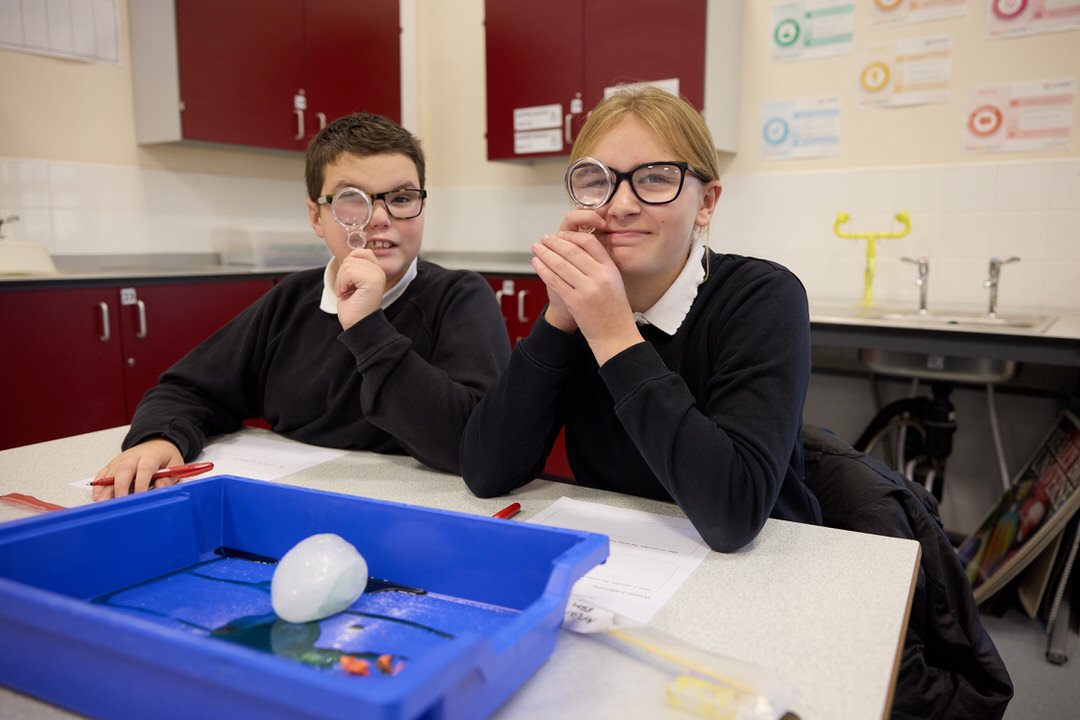
Year 6-9 pupils are taught by the science lead and science teachers in the science laboratory. Pupils build upon the foundations of key scientific concepts learnt in lower school, beginning to think, act and question like a scientist. Pupils work as scientists, carrying out a wide range of exciting and engaging learning opportunities, helping to develop essential science skills needed to investigate and question the world in which they live. Pupils continue to build upon their prior learning; revisiting learnt concepts, layering new ideas, knowledge and skills on top of this as they develop into more confident and independent scientists. Pupils carry out more systematic investigations, analysing and interpreting data to find patterns and relationships in their results, leading them to make evidence-based conclusions. Pupils continue to learn to work as part of a team but gain more independence within the laboratory, being expected to consider equipment choice and how they will gather accurate and meaningful results, adding to the idea of pupils ‘Thinking like a Scientist’. This promotes confident communicators, preparing pupils for their next, accredited, steps in science.
In Year 10 and 11 pupils continue to build on prior knowledge and working scientifically by following either the ASDAN Science short course awards or AQA unit awards. They are programmes that are designed to, ‘motivate and enhance learners' confidence, self-esteem and resilience.’
Our aim, through ASDAN/AQA science, is to give pupils opportunities to reflect on the knowledge and working scientifically skills they have already acquired progressively through the KS2 and KS3 science curriculums and apply this in the context of real-world challenges.
For our pupils this means an exciting opportunity to grow their curiosity, knowledge and understanding of science through its application to current issues, ranging from health, fitness and nutrition, global warming and pollution to car safety and space exploration. This is combined with the development of core skills in teamwork, communication, problem solving and research, thus developing skills which enhance their employability and life experiences.
Science lessons are enhanced through the use of the science laboratory, allowing pupils to access a wide variety of different scientific equipment appropriately and safely. Pupils also have access to a supply of iPads, along with laptops, which are used where possible to add ICT links, helping to further enrich lessons. Science lessons are also enhanced through educational visits and trips, linked to topics, and the use of the school’s grounds.
Our classroom culture in science is one of open mindedness and flexible thinking.
Please click the link below to download curriculum map
Long term plans available on request